M.S. Research by Marie Johnston (completed May 2006)
Brief History:
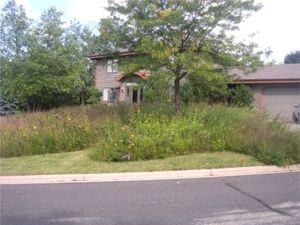
Planting prairie within residential landscapes is a relatively new practice. While prairie vegetation has been suggested to improve soil quality, few studies quantify the potential for prairie plants to improve the porosity of compacted, urban soil. In this study, we test the effects of planting prairie in residential sites within the Madison area, and investigate possible changes in soil structure, fertility, and site hydrology.
The Experimental Design:
We tested prairie gardens by comparing these plantings with adjacent traditional lawn on the same sites. We sampled twelve prairie-lawn pairs at homes in the Madison area. In addition, we asked whether the range of prairie age (0-15 growing seasons) would have a significant effect on changes in soil quality. In the fall, we sampled soil bulk density, soil organic matter, and soil cone penetration resistance. In the following spring, we measured soil field-saturated hydraulic conductivity in situ using a constant-head permeameter.
Our Findings:
The results of this study will be submitted for peer-review publication. This study was also presented at the ASA/CSA/SSSA International Conference in November 2006 at Indianapolis, IN. View my oral presentation (322 KB): Johnston_SSSA_2006.pdf