M.S. Research by Sara Rouse
Introduction:
It is widely known that urbanization commonly compacts soil thereby reducing its macroporosity and pore connectivity. Consequently, rain gardens are gaining popularity with home owners, city planners, and developers due to the coupling of a desirable landscape aesthetic with the potential on-site treatment of storm water. However, because rain gardens constitute a relatively new BMP, quantitative performance data are scarce at best. Moreover, the vast majority of scientific study pertaining to rain gardens has been performed:
- at the level of modeling
- at an experimental scale out of context with the average urban parcel
- with insufficient replication to draw general conclusions
- without sufficient control to test hypotheses
The Experimental Design:
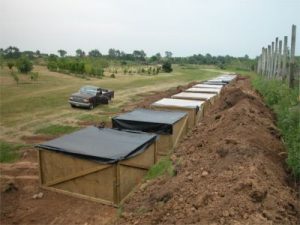
We constructed twelve experimental rain gardens in Verona, Wisconsin during the summer of 2005. To accomplish this work, we have partnered with a local landscaping company, Watts Landscape Service, who has provided practical recommendations and assistance for the design and installation of the gardens. View poster presentation (PDF, 47 KB)
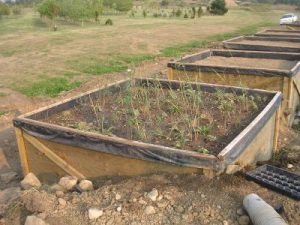
Twelve gardens (2.4m x 2.4m x 1.2m) were placed in a systematic random design:
- 3 blocks with 4 treatments per block
- Control (no vegetation)
- Native prairie mix (Plant mix chosen in consultation with Applied Ecological Services, Broadhead, WI)
- Shrub mix (Plant species chosen by Watts Landscape Service)
- Kentucky bluegrass sod (Poa pratensis)
Our General Questions:
- Will vegetation type affect the water balance within these gardens?
- Will vegetation type affect the remediation of storm water containing urban pollutants?
- Will vegetation type affect the cycling and storage of nutrients and carbon?
I presented this research at the ASA/CSA/SSSA International Conference in November 2006 at Indianapolis, IN. View my oral presentation (474 KB): Rouse_SSSA_2006.pdf